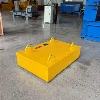
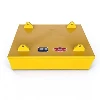
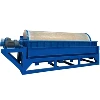
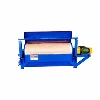
An eddy current separator mainly consists of a permanent magnet drum and a material conveying system (including a material conveyor belt, a conveyor belt drive drum, and a geared motor). It is primarily used for separating plastics, glass, electronic waste, municipal solid waste, municipal wood waste, industrial slag tailings, automotive waste, mixed materials, and various metal mixtures. Eddy current separators significantly improve production efficiency, effectively separating non-metallic materials from non-ferrous metals automatically, reducing labor intensity, and achieving a separation efficiency of over 98%.
Eddy current separation is a separation technology that utilizes the difference in electrical conductivity between materials. Its separation principle is based on two important physical phenomena: an alternating magnetic field that varies with time always produces an alternating electric field (the law of electromagnetic induction); and a current-carrying conductor generates a magnetic field (Biot-Savart law).
During operation, a magnetic drum inlaid with permanent magnets rotates at high speed, generating an alternating magnetic field. When a conductive metal passes through this magnetic field, eddy currents are generated within the metal. Eddy currents generate an alternating magnetic field, which is opposite in direction to the magnetic field generated by the magnetic drum. This creates a repulsive force (Lorentz force) on the metal. Non-ferrous metals (such as copper and aluminum) are propelled forward along the conveying direction due to the repulsive force of the magnetic field, thus separating the metal from the material flow and achieving the purpose of sorting. It primarily distinguishes materials based on the ratio of their conductivity to density; materials with a higher ratio are easier to separate than those with a lower ratio.
Eddy current separators can sort materials of different particle sizes depending on the rotor's rotation direction. They use a high-gradient rare-earth permanent magnet system, have low energy consumption, and are easy to maintain.