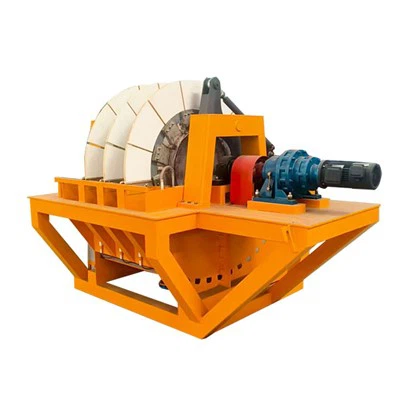
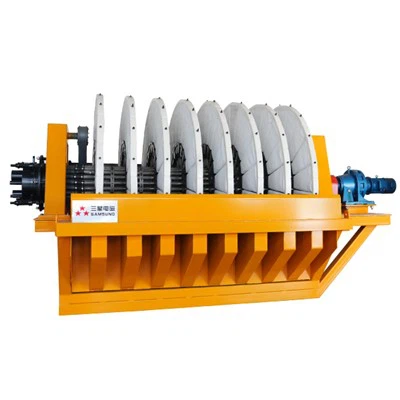
Hey there! As a supplier of RCDB Dry Electromagnetic Separators, I often get asked about the discharge method of these nifty machines. So, I thought I'd take a few minutes to break it down for you.
First off, let's talk a bit about what an RCDB Dry Electromagnetic Separator is. It's a powerful device used to separate magnetic materials from non - magnetic ones in dry conditions. These separators are widely used in industries like mining, recycling, and food processing. They help in getting rid of unwanted magnetic impurities, which can improve the quality of the final product.
Now, onto the main topic: the discharge method. There are a few different ways that RCDB Dry Electromagnetic Separators can discharge the separated magnetic materials, and I'll go through each of them one by one.
Manual Discharge
The simplest discharge method is manual discharge. In this case, once the magnetic materials are attracted to the separator's magnetic field, an operator physically removes them. This is usually done by turning off the magnetic field and using tools like brushes or scrapers to scrape the magnetic particles off.
Manual discharge is pretty straightforward and doesn't require any complex machinery. It's suitable for small - scale operations where the amount of magnetic material to be separated is relatively low. However, it has its drawbacks. It's labor - intensive, which means it can be time - consuming and costly in terms of human resources. Also, the efficiency depends a lot on the operator's skill and attention.
Semi - Automatic Discharge
Semi - automatic discharge is a step up from manual discharge. In a semi - automatic system, some parts of the discharge process are automated, while others still require human intervention.
For example, the separator might have a mechanism that can move the magnetic materials to a certain collection point when the magnetic field is reduced. But an operator still needs to empty the collection container periodically. This method is more efficient than manual discharge as it reduces the amount of direct physical labor. It's a good option for medium - sized operations where there's a bit more magnetic material to handle, but full automation might not be necessary or cost - effective yet.
Automatic Discharge
Automatic discharge is the most advanced and efficient method. In an automatic system, the entire process of discharging the magnetic materials is controlled by the separator itself.
One common way is through a belt - driven system. The magnetic materials are attracted to the surface of the separator, and then a conveyor belt moves them along. Once they reach the end of the belt, the magnetic field is either reduced or reversed, causing the magnetic particles to fall into a collection hopper. This continuous process allows for high - volume separation without the need for constant human supervision.
Another type of automatic discharge uses a rotating drum. The magnetic materials stick to the drum as it rotates, and when they reach a certain point, a scraper or a non - magnetic zone on the drum causes them to be released into a collection area.
Automatic discharge is ideal for large - scale industrial operations where high throughput and consistent performance are crucial. It reduces labor costs, increases productivity, and ensures a more uniform separation process.
Comparison of Discharge Methods
Let's quickly compare these three discharge methods in terms of some key factors:
- Cost: Manual discharge is the cheapest in terms of initial investment as it doesn't require any additional equipment. Semi - automatic systems are a bit more expensive as they have some automated components. Automatic discharge systems are the most costly upfront due to the complex machinery involved, but they can save money in the long run by reducing labor costs.
- Efficiency: Manual discharge is the least efficient as it's slow and prone to human error. Semi - automatic discharge improves efficiency but still has some limitations. Automatic discharge is the most efficient, allowing for continuous and high - speed separation.
- Maintenance: Manual discharge has the least maintenance requirements as there are few mechanical parts. Semi - automatic systems need some maintenance for their automated components. Automatic discharge systems require regular maintenance to ensure the proper functioning of the belts, drums, and other moving parts.
Applications and Considerations
The choice of discharge method depends on the specific application of the RCDB Dry Electromagnetic Separator.
In the mining industry, for example, where large volumes of ore need to be processed, automatic discharge is often the best choice. It can handle the high - throughput requirements and ensure that the magnetic impurities are removed efficiently. On the other hand, in a small - scale recycling plant where the amount of magnetic waste is relatively small, manual or semi - automatic discharge might be sufficient.
When choosing a discharge method, you also need to consider the characteristics of the magnetic materials. If the magnetic particles are large and heavy, a belt - driven automatic discharge system might be more suitable. If they are fine and powdery, a rotating drum system could work better.
Related Products
If you're interested in other types of magnetic separators, we also offer Dry Electromagnetic Powder Magnetic Separator and Electromagnetic Belt Separator. These products have their own unique features and discharge methods, which can be tailored to different industrial needs. Another great option is the RCDD Dry Self - unloading Electromagnetic Separator, which is designed for efficient self - unloading of magnetic materials.
Conclusion
In conclusion, the discharge method of an RCDB Dry Electromagnetic Separator is a crucial aspect that can significantly impact its performance and suitability for different applications. Whether you opt for manual, semi - automatic, or automatic discharge, each method has its pros and cons.
If you're in the market for an RCDB Dry Electromagnetic Separator or want to learn more about the discharge methods and how they can work for your specific needs, don't hesitate to reach out. We're here to help you make the right choice and ensure that you get the most out of your magnetic separation equipment. Let's have a chat and see how we can solve your magnetic separation challenges together!


References
- "Magnetic Separation Technology" - A comprehensive guide on magnetic separators and their operation.
- Industry reports on the use of magnetic separators in mining, recycling, and food processing industries.